

Research Scientist
Meta
PhD in Cognitive Psychology, Goldsmiths, University of London, UK BSc in Electrical Engineering, Sharif University of Technology, Tehran, Iran
I am a cognitive psychologists and a vision scientist. I am interested in understanding reading problems in order to improve the reading experience. Along with Dr. Chandna, I study higher visual function deficits in children with cerebral visual impairment (CVI). Specifically, in collaboration with with Dr. Chandna I lead the research to investigate how CVI affects reading in each child in order to improve or develop individualized (re)habilitation techniques or assistive technologies. In addition, I am interested to understand how TBI (which is a form of CVI) affects reading in adults. I am also interested in binocular vision (stereopsis, fusion, suppression) and how the two eyes work together during daily living tasks in individuals with normal or abnormal vision, such as strabismus or amblyopia. To do so, I use (i) qualitative methods such as as in-depth interviews, surveys and questionnaires and (ii) quantitative methods such as regression, factor analysis and cluster analysis on objective data (e.g., eye-movements and accommodation measurements; behavioural data on psychophysics experiments or EEG). Furthermore, I develop applications that can be used for research or rehabilitation.
Contact Information:
Email: saeideh@ski.org
Office Phone: (415) 345-2064
2318 Fillmore St
San Francisco, CA 94115
Publications


Projects
 ActiveStereopsis in Macular Degeneration
Macular degeneration affects the central retina, often causing asymmetrical damage to the two eyes. How does this asymmetrical loss affect stereopsis — the percept of depth generated by the small separation of image features in the two eyes?
 CompletedUpper Depth Limit Across Visual Field
Stereopsis is important for tasks of daily living such as eye-hand coordination. It is best in central vision but is also mediated by the periphery. Previously we have shown that individuals with central-field loss who have residual stereopsis in the periphery perform better at an eye-hand-coordination task. Here we sought to determine what sets the limit of stereopsis, defined as the largest disparity that supports the sustained appearance of depth, in the near periphery in healthy individuals.
 ActiveAdaptive Visual Strategies for Individuals with Macular Degeneration
In this project we try to gain a better understanding of what visual strategies people use to gather information in the world.
- CompletedThe Window of Spatial Attention in Reading
We investigate the dynamics of spatial attention while the eyes move around to gather information.
- CompletedParafoveal Crowding
Crowding increases with eccentricity, and is most readily observed in the periphery. During natural, active vision however, central vision plays an important role. Measures of critical distance to estimate crowding are difficult in central vision, as these distances are small. Any overlap of flankers with the target may create an overlay masking confound. The crowding factor method avoids this issue by simultaneously modulating target size and flanker distance and using a ratio to compare crowded to uncrowded conditions. This method was developed and applied in the periphery (Petrov &…
 ActiveFovea Use During Smooth Pursuit
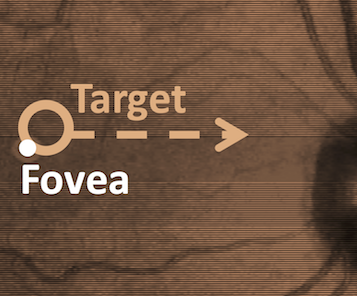
There is continuing debate as to whether smooth pursuit relies on the foveation of a moving target, especially when the target is compact. Previous studies have shown that gaze is placed on the center-of-mass of a target during saccadic eye movements. This research aims to understand whether eye placement is similarly centered during smooth pursuit and whether foveation is necessary for pursuing a small stimulus.
 InactiveState of the Science Conference On Rehabilitation Technology & Methods For a Changing Population
Date: Friday, December 4, 2015
Location: The Smith-Kettlewell Eye Research Institute, 2318 Fillmore St., San Francisco CA 94115
The goal of this invitation-only conference was to identify needs for future research in rehabilitation technology, methods for the blind and visually impaired population, and those with dual sensory loss.
Program:
8:45 – 9:15 Check-in and coffee/pastries9:15 – 9:25 Welcome
9:25 – 9:45 Keynote: Paul Schroeder (link to YouTube video)
9:45 – 10:45 Panel 1: Changing Populations. How should we change our approach to assessing and addressing visual impairments? (link to YouTube…
 CompletedSKERI-VF
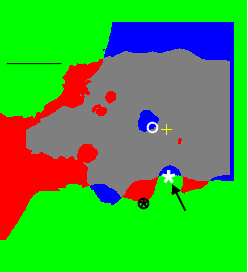
Walker et al (Renninger, Psomadakis, Dang & Fletcher, 2008) suggested a novel method to estimate the monocular scotoma area from perimetry data in macular degeneration based on (i) an optic-disc based estimation of the location of the fovea and (ii) the increase in the receptive field size with eccentricity. Here, Dr Walker and I introduce a new GUI that applies this method to data from the Optos OCT/SLO.
- CompletedImpact of Eye Movements on Reach Performance
Aim 2 of Reaching with Central Field Loss