Publication Types
Abstract
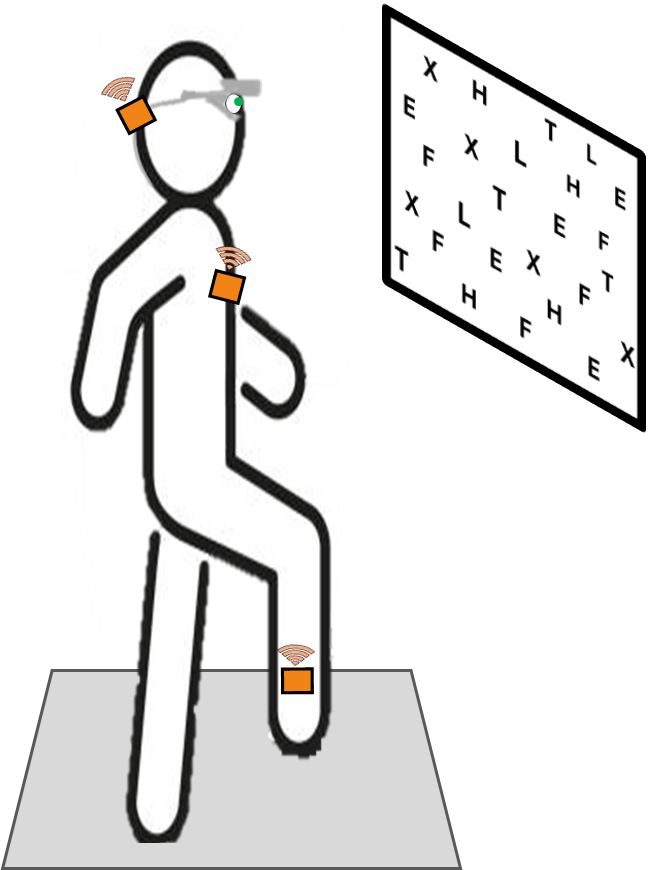
Age-related macular degeneration is the leading cause of visual impairment in older age, damaging the central retina. In AMD, unstable eccentric fixation is commonly observed when employing a peripheral retinal locus, instead of the fovea and may combine with age-related vestibular deficits, thus affecting gaze (eyes + head) stabilization. This can alter body movement patterns and increase fall risk. Head stabilization while moving is critical to maintain a stable reference for the visual, vestibular, and auditory systems, and to better control gaze. There is evidence of functional, active gaze tasks like visual search improving postural and locomotor stability in healthy young adults. These adaptations are possible thanks to the tight link between the postural and gaze systems. It is possible that head stabilization improves when gaze has a more active, and potentially functional role. Should this hold in those with AMD, new training protocols can be developed to improve both oculomotor control and head stabilization, facilitating daily life tasks. Participants included 5 visually healthy older adults (2F, age range: 60-78), one older adult with monocular AMD, (M, 82) and one with binocular AMD (F, 84). They all stepped in place (SIP) with and without performing a visual search task, while their eye and head movements were tracked with an IMU and eye-tracker, respectively. Targets and distractors were projected on a screen (58°×48°) at 2m and participants reported the number of targets found during successive trials (Xs among other letters, between 4 and 9 per trial). The visual search task reduced head motion in several ways, suggesting better stabilization. We found a significant reduction in anteroposterior head acceleration and acceleration variability in all participants, with a greater reduction in those with AMD. A similar trend was found for vertical head acceleration metrics (p=0.07). In addition, we saw a significant reduction in angular velocity in roll during the search task in all participants. Data collection and analysis are ongoing. Findings suggest preserved sensorimotor adaptation abilities in older adults with and without CFL, exhibiting postural adaptation to achieve the supra-postural, visual task. Should we observe consistent results in a larger sample, these outcomes offer promising avenues for rehabilitation and training. How eye movements are used during visual search will also be important to consider to better understand the relationship between the visual, oculomotor and postural components of this task.
Conference Name
Society for Neuroscience (SfN) Annual MeetingConference Location
San Diego, CaliforniaYear of publication
2025