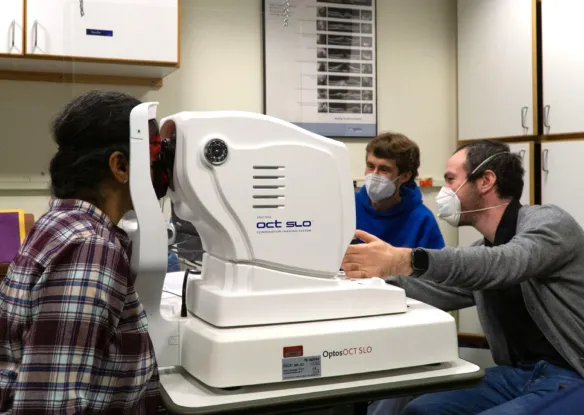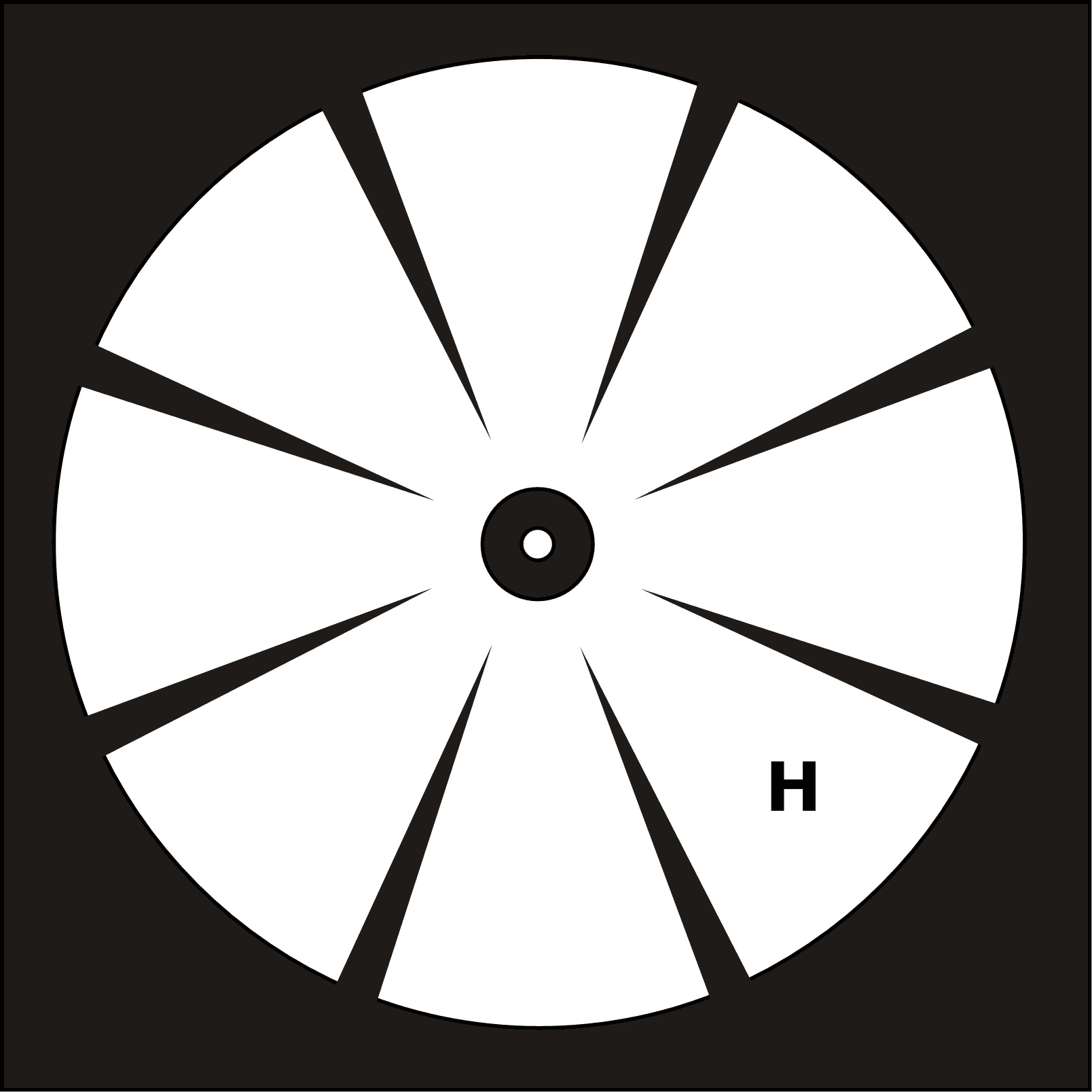
The Macular Mapping Test (MMT) is a tool for the assessment of the topography of vision. It is a quick and low-cost alternative to conventional perimetry in practical low vision care.
While standard perimetry uses a detection task, the MMT measures the recognition of single letters in the center and near periphery (+/- 10 deg) of the visual field. Their sizes increase according to eccentricity and can be shown at different contrast levels. Each letter is displayed only for a brief moment (250 ms). One test run of 36 trials takes only about 3 minutes.
We have tested patients with early age-related maculopathy (ARM) and control subjects of varying ages. In healthy subjects, overall performance at 10% contrast begins to decline linearly as a function of age from the age of 54 years on. The differences between patients and control subjects was enhanced if performance was analyzed at low contrast. In 18/27 patients, whose fellow eye had early signs of a maculopathy, performance was significantly lower than in the control group.
What have we learned? Using parafoveal test locations, a recognition task and diminished contrast increases the chance of detection of functional defects due to early ARM and can differentiate them from those due to aging alone.
Related References
Eisenbarth W, Feucht N, Enders C, Maier M, Lohmann C, MacKeben M. (2015) Parafoveal contributions to retinal function during ranibizumab therapyfor age-related macular degeneration. Can J Ophthalmol. February 2015, Vol. 50, No. 1, 37-43
Hahn GA, Messias A, Mackeben M, Dietz K, Horwath K, Hyvärinen L, Leinonen M, Trauzettel-Klosinski S. (2009) Parafoveal letter recognition at reduced contrast in normal aging and in patients with risk factors for AMD. Graefes Arch Clin Exp Ophthalmol. Jan; 247(1):43-51.
MacKeben M. (2008) Topographic mapping of residual vision by computer. Journal of Visual Impairment & Blindness (Special Issue on AMD), October, Vol. 102, No.10, 649-655. (afb.org)
Trauzettel-Klosinski S, Biermann P, Hahn G, Weismann M. (2003) Assessment of parafoveal function in maculopathy: a comparison between the Macular Mapping Test and kinetic Manual Perimetry. Graefes Arch Clin Exp Ophthalmol. Dec; 241(12):988-95 (pubmed)
MacKeben, M. & Colenbrander, A. (2000) Topographic measurements of low contrast letter recognition as a tool for diagnosis and vision rehabilitation. Vision Rehabilitation (C.Stuen et al., eds), Swets & Zeitlinger, Lisse, p. 158-160
MacKeben, M., Colenbrander, A. and Gofen, A. (1999) Use you PC to quickly map remaining vision after foveal vision loss. Perimetry Update 1998/1999 (M. Wall & J.M. Wild, eds.), Kugler Publications, The Hague, Netherlands.
Normal.dotm 0 0 1 447 2550 SKERI 21 5 3131 12.0 0 false 18 pt 18 pt 0 0 false false false /* Style Definitions */ table.MsoNormalTable {mso-style-name:”Table Normal”; mso-tstyle-rowband-size:0; mso-tstyle-colband-size:0; mso-style-noshow:yes; mso-style-parent:””; mso-padding-alt:0in 5.4pt 0in 5.4pt; mso-para-margin:0in; mso-para-margin-bottom:.0001pt; mso-pagination:widow-orphan; font-size:12.0pt; font-family:”Times New Roman”; mso-ascii-font-family:Cambria; mso-ascii-theme-font:minor-latin; mso-fareast-font-family:”Times New Roman”; mso-fareast-theme-font:minor-fareast; mso-hansi-font-family:Cambria; mso-hansi-theme-font:minor-latin; mso-bidi-font-family:”Times New Roman”; mso-bidi-theme-font:minor-bidi;}
MacKeben, M and Colenbrander, A. (1994) “Mapping the topography of residual vision after macular vision loss.” In: Low Vision-Research and New Developments in Rehabilitation, Kooijman AC et al. (Eds.), IOS Press, Amsterdam, pp. 59-67.
Get Involved
If you are interested in vision science or want to learn more about low vision and blindness, there are many opportunities to get involved at The Smith-Kettlewell Eye Research Institute.