
August 27th, 2026

Smith-Kettlewell’s Adrien Chopin and colleagues found that the rate at which perception flips between two competing images separated adults with amblyopia, or lazy eye, from adults with normal vision, and tracked with the clinical type of the condition.
Highlights
- When each eye is shown a different image, perception alternates between them. In a Smith-Kettlewell-led study, that alternation slowed markedly in adults with amblyopia, commonly called lazy eye.
- About four minutes of tracking those perceptual switches was enough to tell the two groups apart in this sample, and the pattern differed by the clinical type of amblyopia.
- The switching pattern behaves like a biomarker: a rapid, non-invasive signal that flags lazy eye and points to which clinical type it is.
- Because the switches could in principle be read from eye movements rather than button presses, the researchers see a path to testing children too young to describe what they see.
A four-minute test of how perception shifts between the eyes distinguished adults with amblyopia, or lazy eye, from adults with normal vision, Smith-Kettlewell researchers report in a study published in Investigative Ophthalmology & Visual Science.
In the 11 adults with amblyopia the team tested, perception flipped between competing images at a sharply reduced rate compared with eight adults who had normal vision.
The measures also sorted participants by clinical subtype, separating anisometropic amblyopia from strabismic and mixed forms.

What is lazy eye (amblyopia)?
Amblyopia is reduced vision in one eye that develops when the brain and that eye fail to work together properly in early childhood. The eye itself is usually healthy. The problem is in how the brain learns to use it.
It is common. A meta-analysis in the British Journal of Ophthalmology, pooling 60 earlier studies, put global prevalence at 1.44 percent and estimated 99.2 million people had amblyopia worldwide in 2019, rising to a projected 175.2 million by 2030.
The condition takes different forms. Anisometropic amblyopia arises when the two eyes differ sharply in focusing power, so one delivers a blurrier image than the other. Strabismic amblyopia arises from strabismus, a misalignment of the eyes, which sends the brain two images it cannot reconcile. Mixed amblyopia involves both.
What is binocular rivalry?
Binocular rivalry is what happens when each eye is shown a different image and the brain cannot merge them. Instead of blending the two, perception flips back and forth between them on its own, without the viewer choosing.
The phenomenon has been studied for well over a century. What had not been done, Chopin realized, was to revisit it in amblyopia with modern measures.
He had assumed the question was long settled. The classic studies, he said, were never reexamined using reversal rates, the timecourse across a trial, or the mixed states that appear when neither image fully wins.
He raised it with Aubrey Rossi, a student in the Levi Lab at UC Berkeley, who took up the question for her honors thesis.
How the binocular rivalry test for lazy eye works
Participants viewed competing striped patterns through a stereoscope, a device that presents a separate image to each eye, and reported continuously what they were seeing as their perception shifted. Sessions produced as much as 40 minutes of data per person.
Rather than track which eye was winning, the researchers counted the transitions, and separated them into two kinds.
A complete reversal is a clean switch from seeing one eye’s image to seeing the other’s.
An incomplete reversal passes through a mixed percept, a patchy in-between state in which fragments of both images are visible at once and neither has taken over, and comes back to the same initial eye’s image without landing on the other eye’s image.
Counting both, and timing them, gave a dynamic signature of how the two eyes were competing rather than a single snapshot of which one dominated.
Can a four-minute test detect lazy eye?
In this study, yes. Plotting the rate of complete reversals against the rate of incomplete reversals pulled the two groups apart with very little overlap, and about four minutes of data was enough to do it.

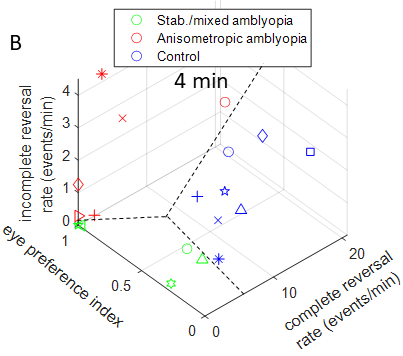
Participants with amblyopia also spent more of the time seeing the fellow eye’s image. Adding that measure, the proportion of time spent seeing one eye, separated the clinical subtypes, placing participants with anisometropic amblyopia in a different region from those with strabismic or mixed forms.
The direction of that split is itself informative. Participants with anisometropic amblyopia showed higher incomplete reversal rates than those with strabismic or mixed forms, which the authors read as a sign of higher binocular noise in anisometropia.
That matters because the subtype shapes what is happening in the brain, and until now no single behavioral measure has reliably told them apart.
How this compares with other binocular rivalry research at Smith-Kettlewell
Separate work at the institute has examined the same phenomenon from another angle.
Chuan Hou and Junxian Rao reported in Vision Research in 2025 that in anisometropic amblyopia the amblyopic eye rarely won out at small image sizes, that boosting the image’s size or contrast partially restored it, and that people with amblyopia spent more time in the mixed, in-between state than people with normal vision.
That study focused on how long each image stayed dominant. Chopin’s team focused on the switches between them, which proved the more sensitive discriminator, and extended the question beyond anisometropia to strabismic and mixed amblyopia.
Together the two describe the same altered competition between the eyes from different directions. Hou has also worked on amblyopia detection directly, using sweep visual evoked potential measures of vernier and grating acuity to identify the condition.
Catching lazy eye in children too young to describe what they see
Current amblyopia assessment can be lengthy, and it depends on what a patient reports seeing. That is a particular difficulty in young children, the group the researchers are ultimately aiming to screen.
The researchers said the reversal patterns could in principle be read from eye movements instead of button presses. That would make the approach workable for children too young to report reliably.
For researchers, the same measures open a window onto interocular suppression, the process by which the brain holds one eye’s input at bay, and onto neural noise in the visual system.
The study is small and was conducted in adults. Confirming the results will require larger groups and testing in children.
The separation the team saw, though, is unusually clean for a condition that has proven hard to capture with any single measure. “No other amblyopia biomarker comes close to that,” Chopin said.
A test that runs in four minutes, asks nothing of a child but that they watch, and reports not only whether amblyopia is present but which kind, would put screening within reach of far more of them. That is the case for pushing this line of work from 19 adults toward the children it was always meant to reach.
That is the goal of the team’s broader project, which is aimed at developing a rapid, objective vision screening tool for preschool children.
Support vision research at Smith-Kettlewell
Research like this is made possible by supporters like you. Your gift funds independent vision research at Smith-Kettlewell, from amblyopia to low vision.
About the study
“Abnormal Binocular Rivalry Dynamics in Amblyopia: A Potential Diagnostic Marker” was published August 3, 2026 in Investigative Ophthalmology & Visual Science, 67(10):66. DOI: 10.1167/iovs.67.10.66.
Authors: Adrien Chopin (Smith-Kettlewell Eye Research Institute; Herbert Wertheim School of Optometry and Vision Science, University of California, Berkeley; Sorbonne Université, INSERM, CNRS, Institut de la Vision, Paris); Aubrey Rossi (University of California, Berkeley; Department of Psychology, University of Oregon); Preeti Verghese (Smith-Kettlewell Eye Research Institute); Michael A. Silver (Herbert Wertheim School of Optometry and Vision Science and Helen Wills Neuroscience Institute, University of California, Berkeley); and Dennis M. Levi (Herbert Wertheim School of Optometry and Vision Science, University of California, Berkeley).
Funding: None reported.
This research was conducted in the Verghese Lab at Smith-Kettlewell, as part of the project Binocular rivalry as a detection tool for amblyopia.
About Smith-Kettlewell
Smith-Kettlewell is an independent nonprofit research institute advancing vision science, accessibility, and innovation to improve understanding, independence, and quality of life. Learn more at ski.org.
Related research at Smith-Kettlewell: Binocular rivalry as a detection tool for amblyopia · Vergence and stereopsis in amblyopia and strabismus · Binocular rivalry and its neural processing in the cortical hierarchy · Effects of stimulus size and contrast on binocular rivalry in anisometropic amblyopia (Hou & Rao, 2025) · Vergence anomalies are associated with impaired stereopsis in amblyopia · A faster, more reliable way to measure visual perception
Learn more about the condition: Amblyopia (lazy eye), National Eye Institute.
Media contact: content@ski.org
Lazy eye and amblyopia: common questions
What is lazy eye?
Lazy eye is the common name for amblyopia, reduced vision in one eye that develops when the brain and that eye stop working together properly in early childhood. According to the National Eye Institute, the brain comes to rely on the stronger eye while vision in the weaker one gets worse. The name is misleading: people with amblyopia are not lazy, and they have no control over how their eyes work.
What causes lazy eye?
In many cases the cause is not known. The National Eye Institute lists three eye conditions that can lead to amblyopia: refractive errors such as nearsightedness, farsightedness or astigmatism; strabismus, in which the eyes do not line up; and cataract, a clouding of the lens. In each, one eye sends the brain a poorer image, and the brain begins to favor the other.
What does a lazy eye look like?
Often it does not look like anything. The National Eye Institute notes that the symptoms can be hard to notice, and that many parents do not know a child has amblyopia until an eye exam finds it. The drifting or turned eye people usually picture is strabismus, which is a separate condition that can lead to amblyopia but is not the same thing.
Is lazy eye genetic?
Not straightforwardly, though family history plays a part. The National Eye Institute lists a family history of amblyopia, childhood cataract or other eye conditions among the factors that raise a child’s chances of developing it, alongside premature birth, low birth weight and developmental disabilities.
What is the difference between lazy eye and strabismus?
Strabismus is a misalignment of the eyes, where one may drift in, out, up or down. Amblyopia, or lazy eye, is reduced vision in one eye caused by how the brain processes what that eye sends. They are different conditions, and strabismus is one of the things that can cause amblyopia. A person can have either alone, or both together.
How common is lazy eye?
It is the most common cause of vision loss in children, affecting up to three in 100, according to the National Eye Institute. Globally, a meta-analysis in the British Journal of Ophthalmology pooling 60 earlier studies put prevalence at 1.44 percent, an estimated 99.2 million people in 2019, projected to reach 175.2 million by 2030.