
July 30th, 2026

Smith-Kettlewell’s Christopher Tyler and colleagues examined how people perceive longitudinal wave motion, the kind that carries sound, and found that the visual system does not see one smooth travelling wave but splits it into forward-moving crests and backward-moving troughs.
Highlights
- A Smith-Kettlewell-led study is the first to ask how the visual system perceives longitudinal wave motion, the back-and-forth oscillation that carries sound and some seismic waves.
- Shown such a wave in a field of moving dots, viewers did not see one travelling wave; their perception was split into crests moving forward and troughs moving backward, an effect the brain builds from the local dot oscillations on the screen.
- A formal analysis finds that physical longitudinal waves are profoundly nonlinear at high amplitudes, a property largely neglected in physics, which means the smooth sinusoidal way sound waves are usually drawn is physically inaccurate.
Sound is a longitudinal wave. As it propagates through space, the medium is displaced forward and back along the same axis as the wave motion, compressing into dense regions and thinning into sparse ones. Longitudinal motion of this kind is fundamental in nature, forming the basis of acoustics and of some forms of seismic transmission, yet it is invisible, and the way it is usually depicted turns out to mislead. A theoretical analysis by Smith-Kettlewell scientist Christopher Tyler and colleagues finds that physical longitudinal wave motion is profoundly nonlinear at high intensities, a property almost entirely neglected in physics, where the motion is nearly always treated as though a sinusoidal drive produced a sinusoidal wave.
Tyler, with Joshua Solomon of City St George’s, University of London, and Stuart Anstis of the University of California, San Diego, set out to see what happens when such a wave is made visible and shown to the eye. If you render a longitudinal wave and ask people what they perceive, what do they report? The question had not been posed.
Longitudinal vs. transverse waves: how sound actually moves
Travelling waves are composed of two kinds of oscillation. In a transverse wave, the one most people picture, the medium is displaced across the direction of travel, as in a wave running down a shaken rope. In a longitudinal wave, the displacement runs along the axis of travel, so the medium bunches and spreads rather than rising and falling. A slinky makes the distinction concrete: push and release one end and a compression runs down its length while each coil only oscillates in place. Sound is wholly longitudinal, a travelling pattern of dense and rarefied air.
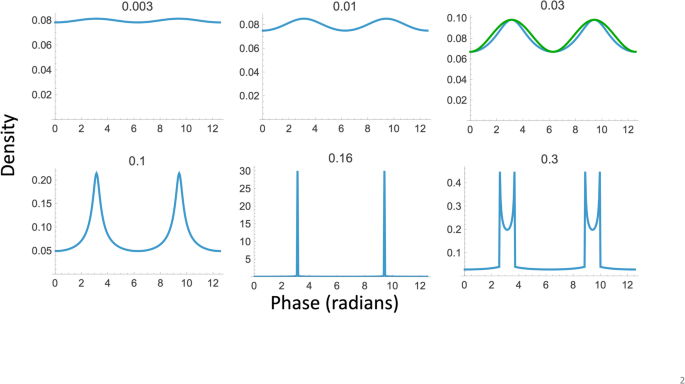
Two things are worth emphasizing: a single particle only oscillates sinusoidally about its home position; what travels is not the particle but the phase of the oscillation, seen as the travelling ripple in the transverse case and as propagating compression bands in the longitudinal case. Raising the amplitude shifts the density wave from a smooth, near-sinusoidal band to a sharp, clumped spike.
How the study made longitudinal wave motion visible
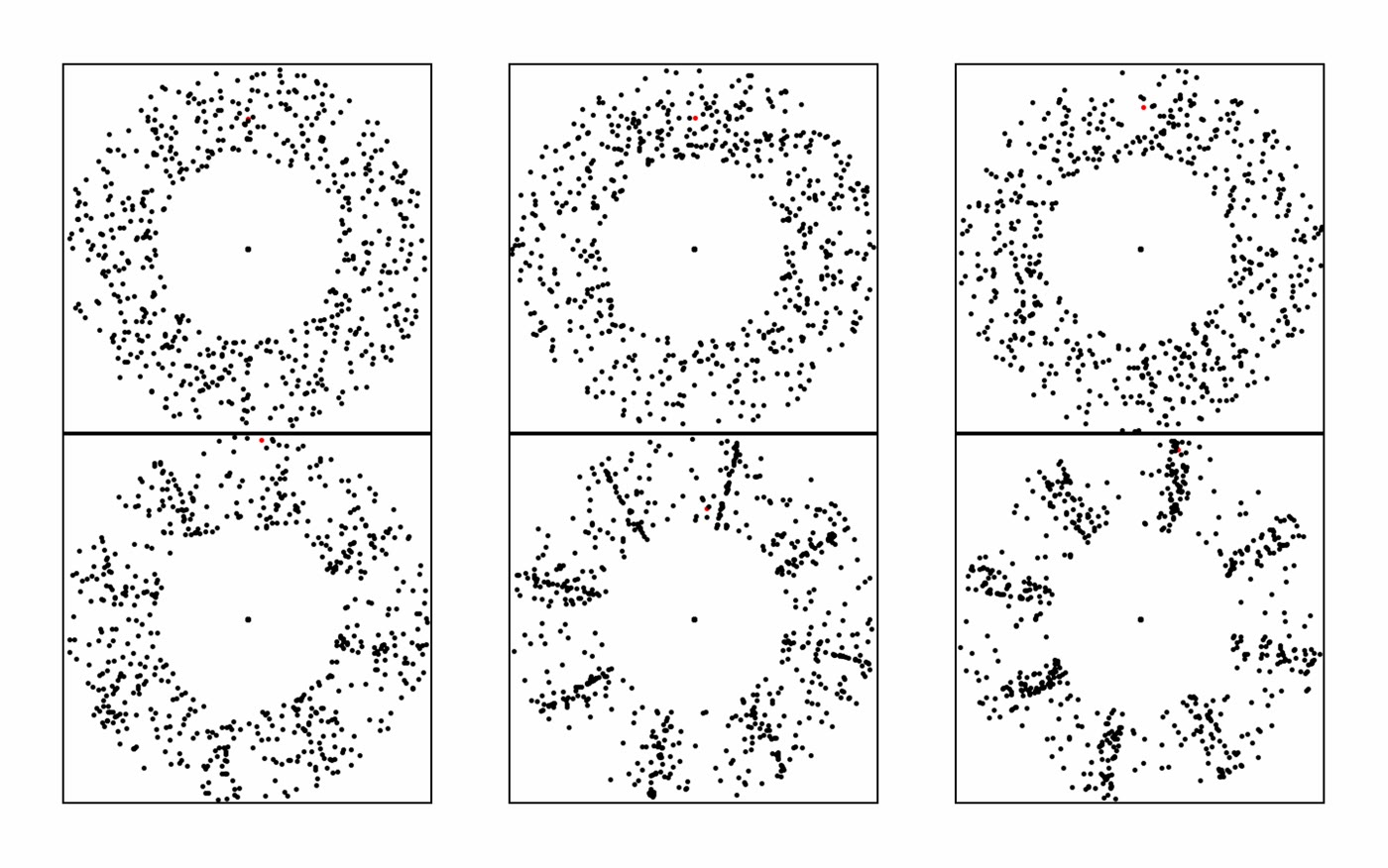
To study the perception directly, the team simulated the molecules of the air as a random-dot field. With the wave made visible, the researchers could do what analysis alone cannot: record what people actually see. The study rests on these perceptual observations, in the psychophysics tradition of using the trained observer as the measuring instrument.
What does the visual system perceive in a sound wave?
It does not see either a single, uniform travelling wave or the individual standing oscillations of each dot in the array. Perceptually, the motion splits into a combination of forward motion of the crests, the dense regions, and backward motion of the troughs, the sparse regions. The effect sharpens with oscillation amplitude. When the maximum velocity of each dot particle equals the wave’s propagation velocity (the speed at which the pattern itself travels), the density function, the curve tracking how tightly the particles are packed across the wave, approximates a narrow spike; at greater amplitudes still, that spike divides into a double spike.
Each of these two percepts can also be switched off. Adding a single, uniform (“rigid”) velocity component to the whole field eliminates either the forward or the backward percept, and, remarkably, the speed needed for that cancellation scales with oscillation amplitude, though nonlinearly so for the forward crest motion. A final test used the motion aftereffect, the brief illusion of reverse motion that follows prolonged viewing of steady motion. Longitudinal waves evoked no aftereffect at any amplitude, until the contrast of the forward crest motion was reduced to make it invisible, at which point an aftereffect emerged from the now-dominant retrograde trough motion.

Why longitudinal-wave perception matters for vision science
Taken together, the results point to a perception that is constructed rather than read off directly. The visual system does not track the physical motion of the particles; it organizes the stimulus into higher-order dynamic Gestalt organizations, and here that organization resolves one wave into two opposing motions that the local stimulus itself does not contain. In the authors’ terms, the findings underline the emergent, or higher-order, nature of the perception of longitudinal travelling wave motion, a concrete addition to what is known about how the brain constructs motion from what falls on the eye.
The work carries a corollary for teaching as well. Because real longitudinal waves are so nonlinear at ordinary amplitudes, the smooth sinusoidal density curves drawn beside sound-wave animations in textbooks and across the internet are, as the analysis shows, inaccurate. Indeed, the dynamic simulations on internet physics websites make the nonlinear density profile visually apparent even though the analytic curves are purely sinusoidal, setting up a cognitive dissonance in the alert student that remains unresolved in the textbook specifications. A truer depiction is at once better physics and a closer match to what the eye actually perceives.
Support vision research at Smith-Kettlewell
Research like this is made possible by supporters like you. Your gift funds independent, curiosity-driven vision science at Smith-Kettlewell, from how the eye works to how the brain makes sense of what it sees.
About the study
“Visual perception of longitudinal waves: theory and observations” was published in 2026 in Scientific Reports (open access). DOI: 10.1038/s41598-026-36204-y.
Authors: Christopher W. Tyler (Smith-Kettlewell Eye Research Institute; City St George’s, University of London); Joshua A. Solomon (City St George’s, University of London); and Stuart M. Anstis (University of California, San Diego).
Funding: N/A.
About Smith-Kettlewell
Smith-Kettlewell is an independent nonprofit research institute advancing vision science, accessibility, and innovation to improve understanding, independence, and quality of life. Learn more at ski.org.
Media contact: [TBD]
