
March 22nd, 2024
Smith-Kettlewell’s Rehabilitation Engineering Research Center (RERC) on Blindness and Low Vision, funded by the National Institute on Disability, Independent Living and Rehabilitation Research (NIDILRR ), supports eight projects related to visual impairment and assistive technologies. Several RERC project leads and researchers presented their latest work at the CSUN 2024
conference in Anaheim, California from Mar 18-22. The CSUN Assistive Technology Conference is the premier forum on technology for all persons with disabilities that provides a platform for researchers, practitioners, educators, exhibitors and more from around the world to engage with each other and share knowledge, innovations and best practices to promote inclusion for all.
RERC researchers who presented this year at CSUN:
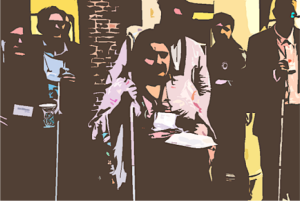 Dr. Catherine Agathos, postdoctoral fellow at SKERI, gave a presentation, “Self-Reported Mobility Difficulties in Macular Degeneration
,” addressing the underappreciated connection between mobility difficulties and central field loss due to macular degeneration. In collaboration with Dr. Don Fletcher, a leading ophthalmologist in the field of low vision rehabilitation, the researchers found that just a few basic questions regarding mobility during routine consultation can significantly change the course of the visit and reveal a major limitation in patients’ daily lives. Resulting increase in referrals to physical therapy and orientation and mobility specialists can potentially address these limitations improving safety and quality of life in those with low vision due to central visual field loss.
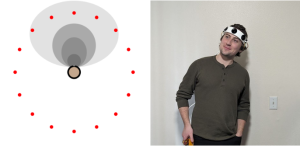 Dr. Santani Teng, Associate Scientist at SKERI, presented his work, “Design and Optimization of Assistive Ultrasonic Echolocation
,” which will be published in the 2024 edition of the CSUN Journal
. This work, done in collaboration with Ian Reynolds, describes “Robin,” a prototype wearable device for human echolocation drawing inspiration from echolocating bats, which is designed to help people with visual impairments learn to use echolocation cues for mobility and understanding the nearby 3D environment.
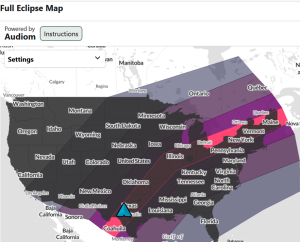
Brandon Biggs, Engineer at SKERI, PhD student at Georgia Tech and Founder of XR Navigation
, gave three presentations related to his work on Audiom, a non-visual web-based map viewer: “The First WCAG AAA Compliant Digital Campus Map ,” “The Future of Inclusive Digital Indoor Maps and Navigation,” and “The Digital Drawing WYSIWYG Editor for Blind Users is Here
.” In Audiom, the user is an avatar that navigates, using the arrow keys, through geographic data, as if they are playing a first-person, egocentric game. The resulting audio virtual reality interface thereby makes digital maps usable by persons with visual impairments. Audiom is a first of its kind tool that provides rich, multimodal information usually only available to sighted users through maps, to all users who are blind or visually impaired.
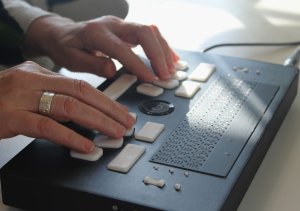
Dr. Sile O’Modhrain, Associate Professor of Information Science at University of Michigan, CIO of NewHaptics
, and one of the RERC investigators, participated in an exhibition of NewHaptics’ refreshable braille display
– one of Dr. O’Modhrain’s many exciting projects in the assistive technology space. This project focuses on making a compact, portable, and large-area tactile “screen,” which has the potential to make a multi-line tactile display that allows a user to interact with braille documents and tactile graphics that can change dynamically over time.
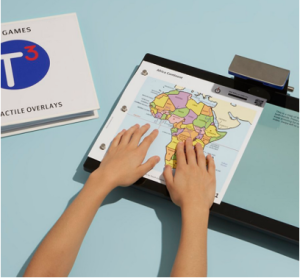
Steve Landau, President and Founder of Touch Graphics
, demonstrated his company’s new T3 Creator system, which makes it easy to create audio labels for tactile graphics using the T3 Tactile Tablet
. This system will expand the range of tactile graphics that can be consumed by people who have limited knowledge of braille or limited experience interacting with tactile graphics.
This conference provided not only a forum for our researchers to exhibit their work but also an opportunity to learn about other key advances and major problems in the field, as well as invaluable feedback from fellow researchers, members of the blind and visually impaired community, as well as practitioners and educators, all of whom have important perspectives on the broad and dynamically changing field of blindness and low vision rehabilitation.
Projects
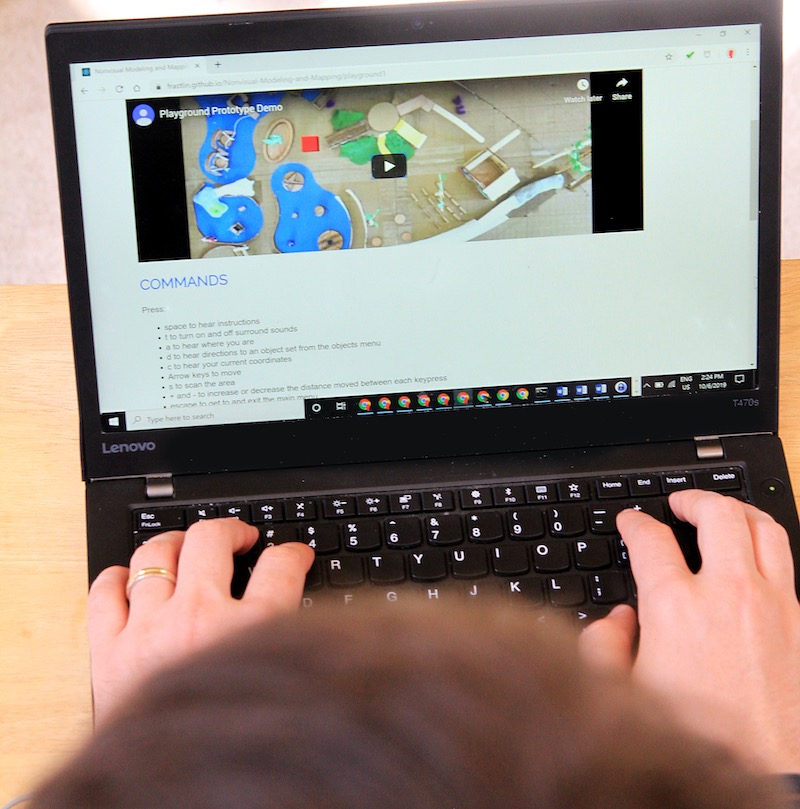
Audiom
Audiom is a tool that allows blind and visually impaired individuals to view maps completely in audio. It is a web component and can be embedded into any webpage, similar to Google Maps. It allows non-visual use of route, landmark, and survey knowledge, which is the critical information needed for navigation.
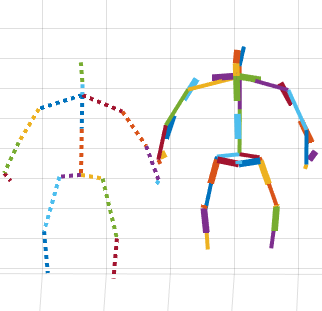
Mobility and Fall Risk in Central Visual Field Loss
Age-related macular degeneration (AMD) is the most common cause of vision loss in the developed world. Central visual field loss due to diseases such as AMD is a large and growing problem. It is also associated with higher risk of falls and, therefore injury. Although much has been done to understand visual limitations associated with this condition, one of its most dangerous and poorly understood outcomes is the increase in the risk of falls, which can be debilitating and even deadly, especially in the age group most affected by AMD. The exact reasons for the increased fall risk are unknown…
Postdoctoral Training in Vision Research
The Smith-Kettlewell Eye Research Institute (SKERI) is an NEI Institutional Training Grant Awardee. The grant was awarded to provide postdoctoral training in basic and clinical science relevant to translational vision research and rehabilitation.

Human Echolocation
What is echolocation? Sometimes, the surrounding world is too dark and silent for typical vision and hearing. This is true in deep caves, for example, or in murky water where little light penetrates. Animals living in these environments often have the ability to echolocate: They make sounds and listen for their reflections. Like turning on a flashlight in a dark room, echolocation is a way to illuminate objects and spaces actively using sound.
Labs
 Eye-Head Movement LaboratoryOur laboratory is interested in how changes in visual and/or vestibular function affect eye/head coordination, balance, and mobility, particularly in aging. We are currently pursuing two main lines of research:...
 Coughlan LabThe goal of our laboratory is to develop and test assistive technology for blind and visually impaired persons that is enabled by computer vision and other sensor technologies.
 Teng LabParticipate in our studies! Visit Teng Lab Experiment Participation for details. Welcome to the Cognition, Action, and Neural Dynamics Laboratory We aim to better understand how people perceive, interact with, and...
Centers
 Rehabilitation Engineering Research CenterThe Center's research goal is to develop and apply new scientific knowledge and practical, cost-effective devices to better understand and address the real-world problems of blind, visually impaired, and deaf-blind...