
Visual-Impairment Research Agenda for Description (VIRAD)
A systematic road map charting gaps in the quantitative evidence about how description can and should be used to improve video usability for the blind.
The Smith-Kettlewell Video Description Research and Development Center is proud to be working with the WGBH NCAM
to develop the Visual-Impairment Research Agenda for Description (VIRAD). While many focus groups, advisory panels, and expert practitioners have contributed to the accumulation of anecdotal evidence to guide the creation and delivery of description, there remains a surprising dearth of evidence-based best practices in this field…
Remote Real-Time Description (RRTD)
Remote real-time description (RRTD) is a simple technique that will allow a describer anywhere in the world to provide real-time description for a video stream being viewed by a visually-impaired student at home, in the classroom, or on the go. In RRTD, a video feed is streamed to the describer who passes the audio (and optionally the video) to the student, along with the added live description.
Expanded Populations Research Agenda for Description (EPRAD)
Bridge Multimedia is collaborating with the VDRDC and the DLN to develop EPRAD, a research road map to identify the critical questions that will improve our evidence-based understanding of how description may apply to the education of students with non-visual disabilities such as ADHD and autism.
Bridge’s work on the Expanded Populations Research Agenda for Description (EPRAD) will identify the concrete research questions necessary to quantitatively assess the value of description for these expanded populations. EPRAD also dovetails with the Visual-Impairment Research Agenda for Description…
Crowd-Sourced Description for Web-Based Video (CSD)
The Descriptive Video Exchange Project focuses on crowd-sourced techniques for describing DVD media.
Choreographed and Orchestrated Video Annotation (COVA)
Choreographed and Orchestrated media refers to a relatively new concept involving different aspects of a coordinated media presentation coming from different networked devices. In this case, COVA will allow video annotations such as audio descriptions to be played from a personal device such as a smartphone, while a primary video presentation is being played on a completely separate device such as a projector in a theater.
Algorithmic Automated Description (AAD)
Automated algorithmic description (AAD) uses existing machine-vision techniques to automate specific aspects of description such as camera motion, scene changes, face identification, and the reading of printed text. Such events could be identified by computer routines that automatically add annotations to the video.
Completed
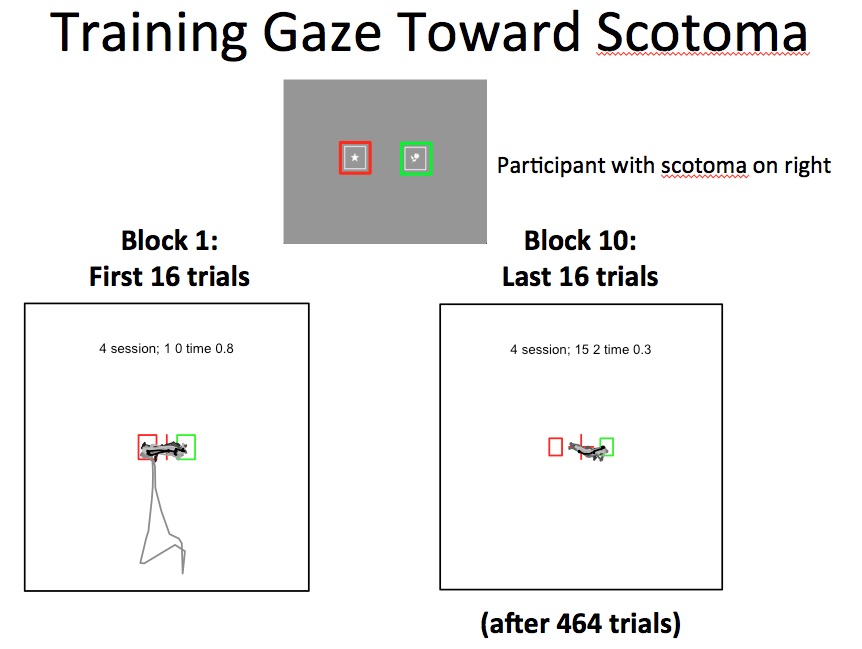
Novel Method to Teach Scotoma Awareness
This project aims to improve visual function in individuals with age-related macular degeneration (AMD). AMD isassociated with central field loss that cannot be corrected optically. Individuals with AMD are often unaware of their scotoma and their eye movements follow more random patterns, compared to adults with healthy vision. With funding from the National Institutes of Health and Pacific Vision Foundation, we are training indviduals with AMD to direct their eye movements into their scotoma, so that they can sample missing information.
Sensorimotor Adaptation as a Function of Age and Experience
Aim 3 of Reaching with Central Field Loss
Impact of Eye Movements on Reach Performance
Aim 2 of Reaching with Central Field Loss
Reach Performance in the Absence of Eye Movements
Aim 1 of Reaching with Central Field Loss