Publication Types
Abstract
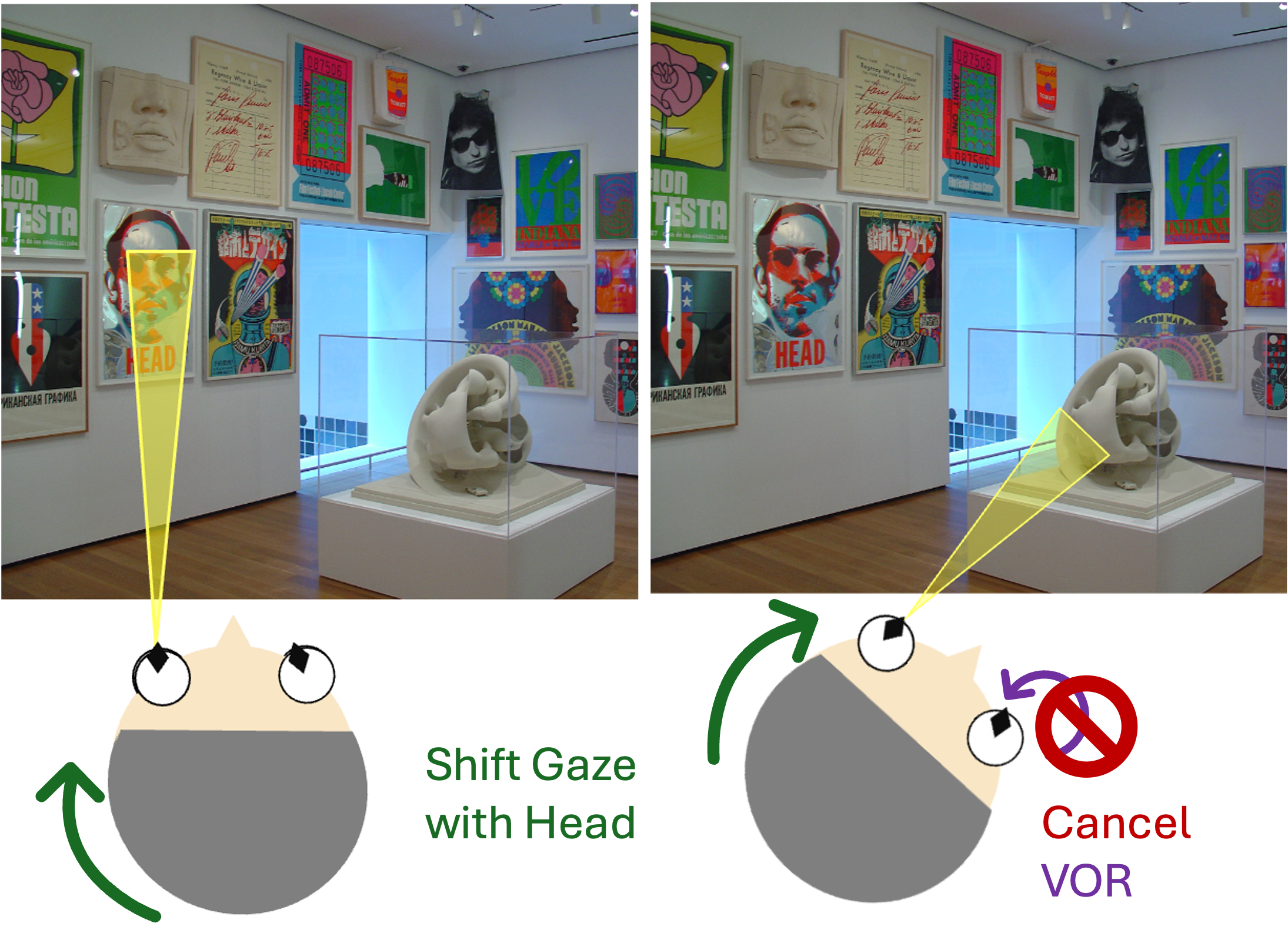
Introduction: Macular degeneration is associated with loss of central vision, including the fovea. Central visual field loss is associated with impaired smooth pursuit eye movements, and the associated scotoma can lead to target disappearance which may or may not be transient. While smooth pursuit in and of itself does not require a foveal position signal, suppression of the vestibuloocular reflex (VOR) needed during combined eye and head pursuit relies on the fovea for appropriate calibration. Prior work has shown that target extinction during, or even at the beginning of the trial does not affect the dynamics of the eye or head responses necessary for pursuit. These findings suggest that the potential disappearance of the target into the scotoma during pursuit can be overcome, particularly when both eye and head movements are used. The objective of this study was to test the hypothesis that head-unrestrained smooth pursuit deficits in CFL are at least partially related to individuals’ inability to cancel their VOR.
Methods: We performed a secondary analysis of a previously published data set of head restrained and unrestrained pursuit of a 10 °/s target in 7 individuals with maculopathy (56-89 years) and 7 age-matched controls (61-78 years). We used a two-parameter linear regression model to quantify the eye-only pursuit (Kfix) and VOR (Kv) contributions to determine whether participants were able to effectively cancel the VOR to improve pursuit gain.
Results: We observed reduced pursuit velocities in the head-unrestrained versus restrained smooth pursuit condition (Kfix < 1), particularly in the control group (CFL: Kfix = 0.90 ± 0.16; Control: Kfix = 0.74 ± 0.08). For VOR cancellation, Kv estimates did not deviate from -1 for either of our groups (CFL: Kv = -0.92 ± 0.09; Control: Kv = -0.98 ± 0.20), suggesting complete cancellation of the VOR during head-unrestrained pursuit. For the self-generated VOR experiment, participants in both groups had similar, near-one VOR gains (CFL: GainVOR =-1.00 ± 0.05; Control: GainVOR = -1.03 ± 0.02).
Discussion: We confirmed that VOR responses to actively generated head movements were similarly intact in both groups. Our analyses of the pursuit data indicate that, regardless of visual function older adults attenuate eye-driven pursuit when the head is unrestrained (as compared to the restrained condition), and those with CFL fail to exploit residual VOR cancellation, helping to explain their persistent gaze-tracking deficits.
Journal
Frontiers in NeurologyVolume
16Year of publication
12/2025