Publication Types
Abstract
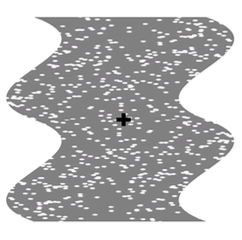
In macular degeneration (MD), depth perception from binocular disparity is impacted in regions with vision loss in either eye, but monocular cues like motion parallax remain available. This study investigates whether combining motion parallax with disparity improves depth perception and compensates for the loss of depth due to central field loss (CFL). Eleven MD participants and 19 controls viewed a horizontal sine-wave corrugation in depth, defined by disparity and/or motion parallax, judging which half-cycle appeared farther away in depth. We measured thresholds for each cue alone and for the two cues combined. In MD participants, cue integration benefits depended on scotoma characteristics. Disparity performance correlated strongly with the size of the stereoblind zone, while motion parallax thresholds showed no significant relation, suggesting preservation despite CFL. MD participants with extensive stereoblind zones showed elevated thresholds for both single cues compared to controls but demonstrated optimal integration when disparity was added to motion parallax. Those with small stereoblind zones achieved control-like thresholds and exhibited optimal or better than predicted integration. However, asymmetric patterns emerged with suboptimal performance when motion parallax was added to threshold disparity. Controls with simulated scotomas maintained stable integration, contrasting with variable patterns in MD. Our results show that individuals with CFL retain significant capacity for depth cue integration, contingent upon residual binocular disparity. Thus, motion parallax emerges as a valuable compensatory cue to improve depth perception in individuals with MD.
Journal
Journal of VisionVolume
26Year of publication
2026