Publication Types
Abstract
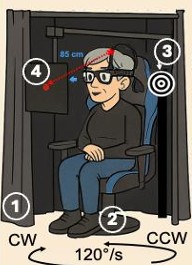
Noise exposure has been implicated hearing loss and possible damage to the vestibular periphery, although functional studies of vestibular function have shown mixed results. A likely barrier to detection and diagnosis of noise-induced vestibular loss is the difference in susceptibility to noise damage of certain components of the vestibular system. Of the three classes of vestibular afferents, calyx-only afferents exhibit irregular firing rates and phasic responses related to head acceleration. They are also sound sensitive and may thus be susceptible to noise overstimulation. Irregular afferents are also key for VOR gain adaptation. To examine potential effects of noise exposure on VOR adaptation, we tested 7 participants (3M, age: 37–76) with varying degrees of noise exposure. Participants wore an EyeSeeCam Sci binocular eye tracker (250 Hz/eye) and were tested in the dark in 3 conditions: no visual stimulus (VOR), world-fixed visual stimulus (vVOR), and a head-fixed visual stimulus (VOR cancellation). Participants were seated in a chair that rotated in yaw with velocity steps randomized for speed (90 and 120°/s) and direction (CW/CCW). The chair accelerated to a desired angular velocity and rotated for 1 second before slowing down and returning to the initial position. Each participant underwent 60 rotations (15 for each speed and direction). Earth-fixed target placement was optimized to be in participants’ field of view during steady state rotation and participants were asked to fixate it as soon as the target became visible. For vVOR cancellation trials, participants were asked to fixate the dot continuously while rotating. In the VOR condition, participants were asked to keep their eyes open and look straight ahead at trial start. Chair and eye signals were synchronized with an IMU mounted to the chair. Head and chair angular velocity was filtered with a fourth order Butterworth low-pass filter (3 Hz cutoff frequency). Blinks and saccades were removed manually. VOR gains were calculated as the ratio of eye and head velocity and averaged across the two eyes. Lifetime noise exposure was assessed using the Noise Exposure Structured Interview (NESI). We did not observe a relationship between VOR gain and noise exposure for any of the conditions (p>0.05, Pearson correlation). There was a significant association between age and VOR responses in the VOR cancellation condition (R=0.83, p = 0.02). Our findings may suggest that noise exposure may not affect irregular afferent activity in the semicircular canals. However, additional data are needed to determine if noise exposure can enhance age-related changes in VOR cancellation.
Conference Name
Society for Neuroscience (SfN) Annual MeetingConference Location
San Diego, CaliforniaYear of publication
2025