Publication Types
Abstract
Age-related macular degeneration (AMD) is the leading cause of vision loss in industrialized countries and, when present in both eyes, can lead to central visual field loss (CFL). This loss of foveal vision significantly impacts mobility and quality of life, increasing the risk of falls. While much is known about the visual implications of the disease, less is known about how loss of vision and loss of the fovea interacts with the aging vestibular system.
Prior work (González et al., 2018) reported increased variability and directional asymmetries in vestibulo-ocular reflex (VOR) gain during active, sinusoidal head rotations in individuals with CFL. While the mean gains also appeared higher in CFL, no significant difference was reported. They also observed a right-left gain asymmetry, consistent with the oculomotor reference shifting to an eccentric preferred retinal locus (PRL) from the non-functional fovea. Whether similar changes emerge during passive rotations remains unknown.
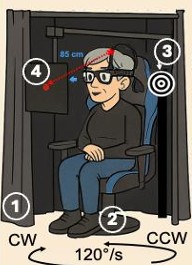
In this preliminary study, we tested VOR gain during passive yaw rotations in total darkness using a motorized, chair-fixed setup designed to isolate reflexive VOR responses. We tested one participant with CFL (F, 84) and two older controls (2M, 71-76). All participants had no history of vestibular deficits. Eye and head movements were recorded using an EyeSeeCam Sci binocular eye tracking goggles (250 Hz/eye). The head was immobilized relative to the chair, so the head and body rotated in tandem. The participants underwent velocity step rotations in yaw applied randomly at two speeds (90°/s, 120°/s) in clockwise (CW) and counterclockwise (CCW) directions.
The CFL participant had greater (CFL: mean gain = -0.76; Controls: mean gain = -0.54) and more variable VOR gains (across speeds and directions, CFL: range = 0.29; Controls: mean range = 0.08) and greater directional asymmetry in gain between CW versus CCW steps (CFL: CCW/CW = 1.32; Controls: CCW/CW = 0.94). Notably, the asymmetry was consistent with the participant’s PRL location to the left of the fovea, with her having smaller leftward than rightward VOR responses. Binocular coordination also appeared more variable in the participant with CFL.
Data collection is ongoing. If these findings extend to future participants, results suggest that central vision loss alters core vestibular reflexes, even under conditions that isolate brainstem-level VOR activity. The data also provide further evidence of PRL re-referencing as an oculomotor anchor.
Conference Name
Society for Neuroscience (SfN) Annual MeetingConference Location
San Diego, CAYear of publication
2025