

September 1st, 2022
Smith-Kettlewell is proud to announce the newly awarded Rehabilitation Engineering Research Center (RERC) grant on Blindness and Low Vision. This is a five-year grant from the National Institute on Disability, Independent Living, and Rehabilitation Research, establishing Smith-Kettlewell as a center promoting the independence and well-being of people with visual impairments through research and development to improve the understanding of, and provide solutions for, challenges facing the blind and low-vision community.
Smith-Kettlewell has been the RERC on Blindness and Low Vision for half a century. In this time, the RERC (augmented by other important funding sources including the National Eye Institute and Smith-Kettlewell) has supported a number of R&D projects. A few examples include:
- TMAP (Tactile Maps Automated Production), which is now a commercial service that allows anyone to order a tactile map of any neighborhood in North America
- YouDescribe, a free, web-based platform for adding audio description to YouTube videos
- Talking Signs, a technology to make informational signs fully accessible
- SKILL (Smith-Kettlewell Institute Low Luminance) Card vision test
- The first auditory oscilloscope for blind users
Many of the RERC achievements can be found on the Accomplishments page.
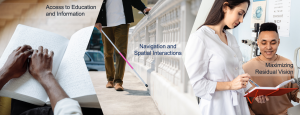
The new RERC grant will support a total of eight projects within three main areas of focus, led both by researchers at Smith-Kettlewell and by outside collaborators. These projects include: (a) access to education and information (Audio-Tactile Media, AI-Enhanced Video Accessibility for YouDescribe and a Smith-Kettlewell Summer Institute); (b) navigation and spatial interactions (Mobilizing Non-Visual Digital Maps, VR Tools and Training to Improve Auditory Environmental Perception and AI Tools for Micro-Navigation); and (c) optimizing function with residual vision (Assessment and Rehab of Higher Visual Function Deficits for Cerebral Visual Impairment and Strategies to Improve Walking Safety with Central Field Loss).
Projects
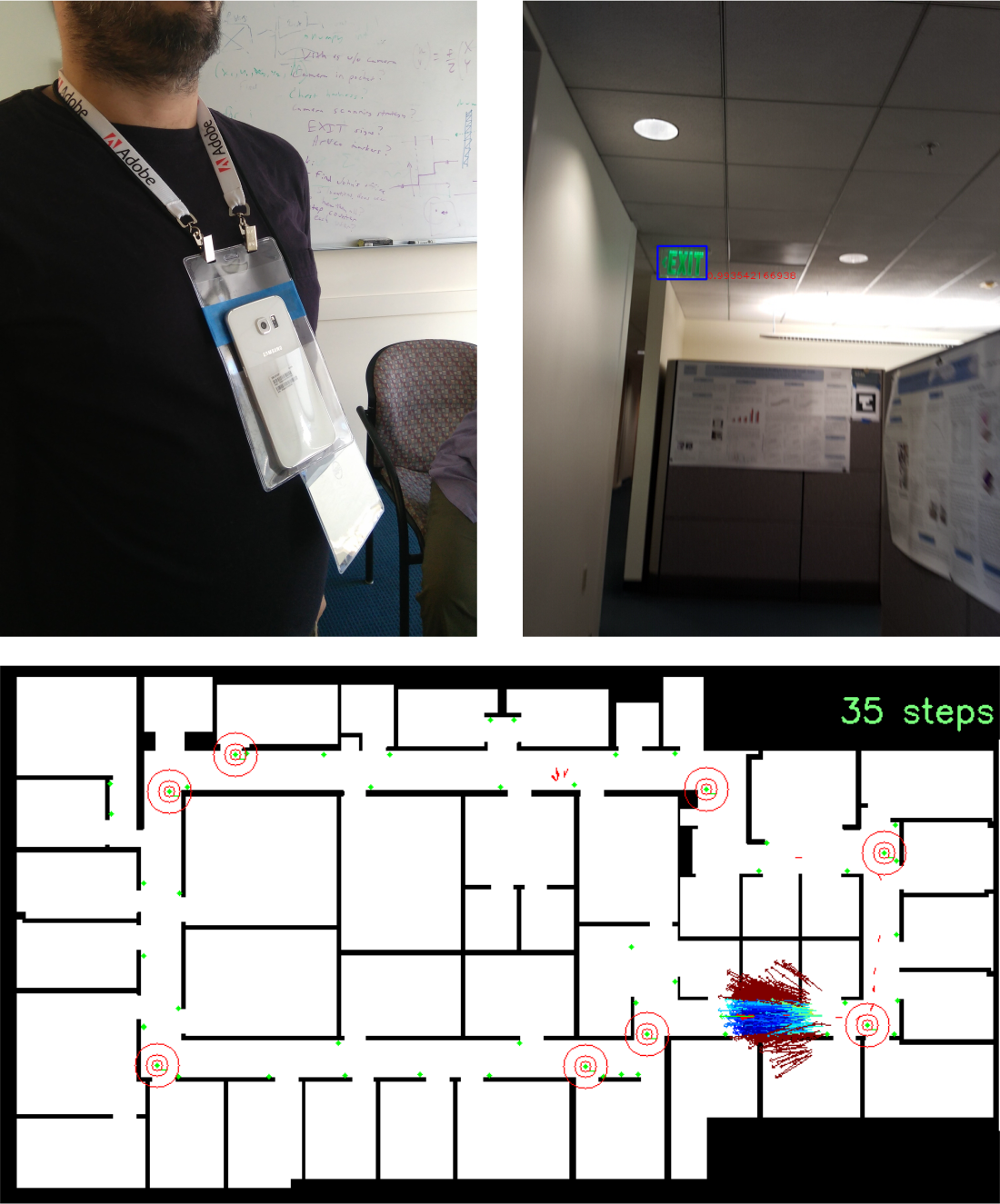
A Computer Vision-Based Indoor Wayfinding Tool
The ability to navigate safely and confidently is a fundamental requirement for independent travel and access to many settings such as work, school, shopping, transit and healthcare. Navigation is particularly challenging for people with visual impairments, who have limited ability to see signs, landmarks or maps posted in the environment.

Talking Signs
Created by William Loughborough in 1979, Talking Lights was a system of infrared transmitters and receivers allowing blind and visually impaired travelers to quickly and easily “read signs” at a distance.
Labs
 Eye-Head Movement LaboratoryOur laboratory is interested in how changes in visual and/or vestibular function affect eye/head coordination, balance, and mobility, particularly in aging. We are currently pursuing two main lines of research:...
 Coughlan LabThe goal of our laboratory is to develop and test assistive technology for blind and visually impaired persons that is enabled by computer vision and other sensor technologies.
Centers
 Rehabilitation Engineering Research CenterThe Center's research goal is to develop and apply new scientific knowledge and practical, cost-effective devices to better understand and address the real-world problems of blind, visually impaired, and deaf-blind...