

September 5th, 2023
Dr. James Coughlan has been awarded funds to increase access to his CamIO tool for making objects accessible to blind and visually impaired persons. The funds were part of NIH’s Notice of Special Interest for Administrative Supplements to Enhance Software Tools for Open Science and will allow Dr. Coughlan and his team to enhance the CamIO software to lower the barriers to researchers who wish to incorporate it in their own projects or test it out for their own applications.
Briefly, CamIO is a tool intended to make physical objects, including documents, tactile maps and 3D objects such as architectural models and appliances, fully accessible to people who are blind or visually impaired. In the system design, the user provides input to the system by pointing to a target on a 3D or 2D object and hears audio feedback about the target. CamIO has previously been successfully implemented as part of the Magic Map installation at the Magical Bridge Playground in Palo Alto.
With the additional funds, Dr. Coughlan and his team plan two major enhancements to the CamIO software: a restructure the software with the goal of making it easier for others to incorporate in their own accessibility projects, and the creation of SKIstream, a rapid prototyping and debugging tool for use with CamIO and similar accessibility projects.
Projects
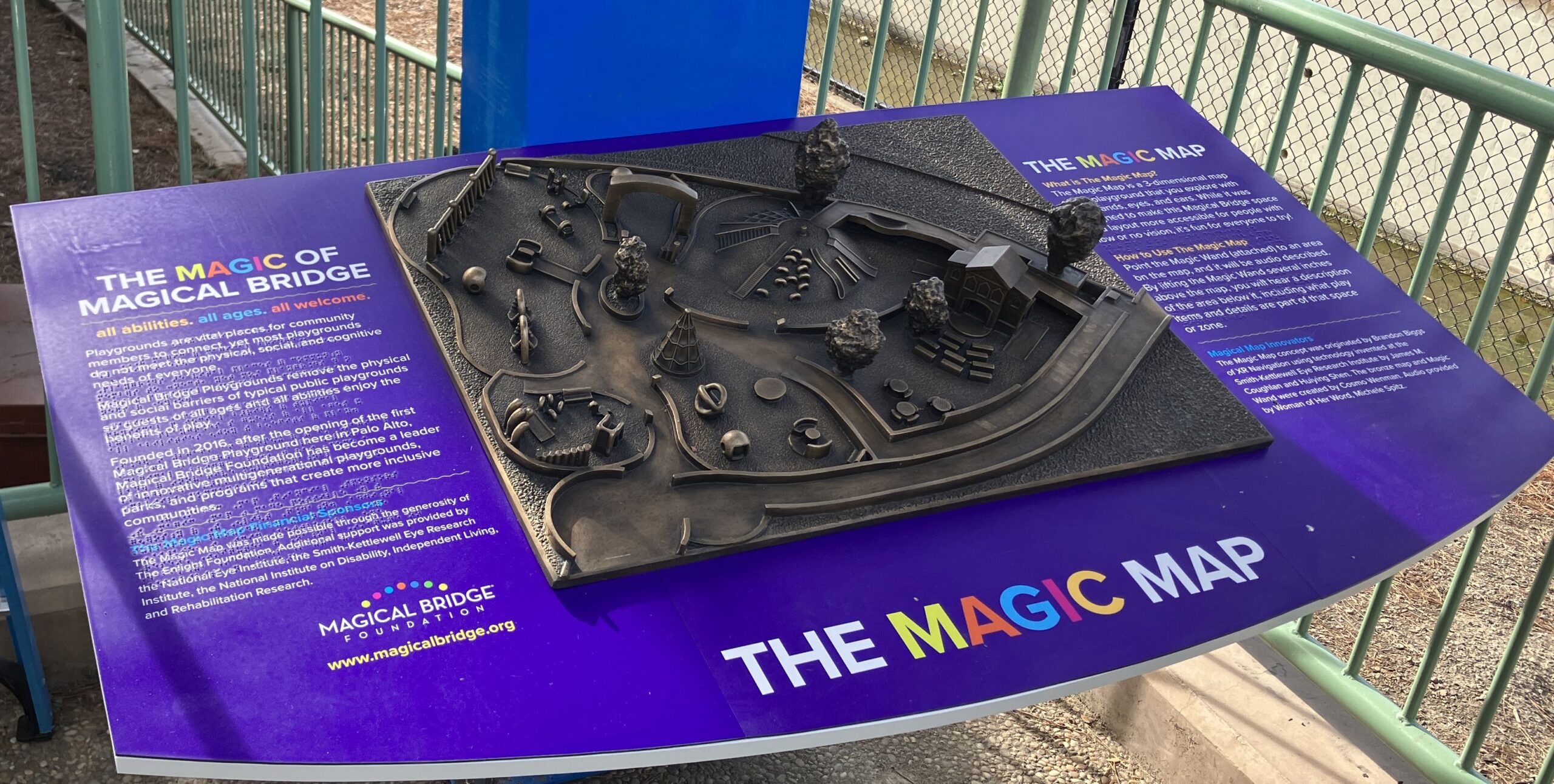
Magic Map
The Magic Map is an interactive 3D map installed at the Magical Bridge Playground in Palo Alto, California. It consists of a 1/100 scale 3D bronze representation of the playground, which includes over seventy play structures organized into multiple play zones and paths. When the user’s index fingertip touches a specific feature on the map, the name and description of the feature are read aloud in audio. This interactivity allows visitors with visual impairments to navigate the map without requiring them to read braille.
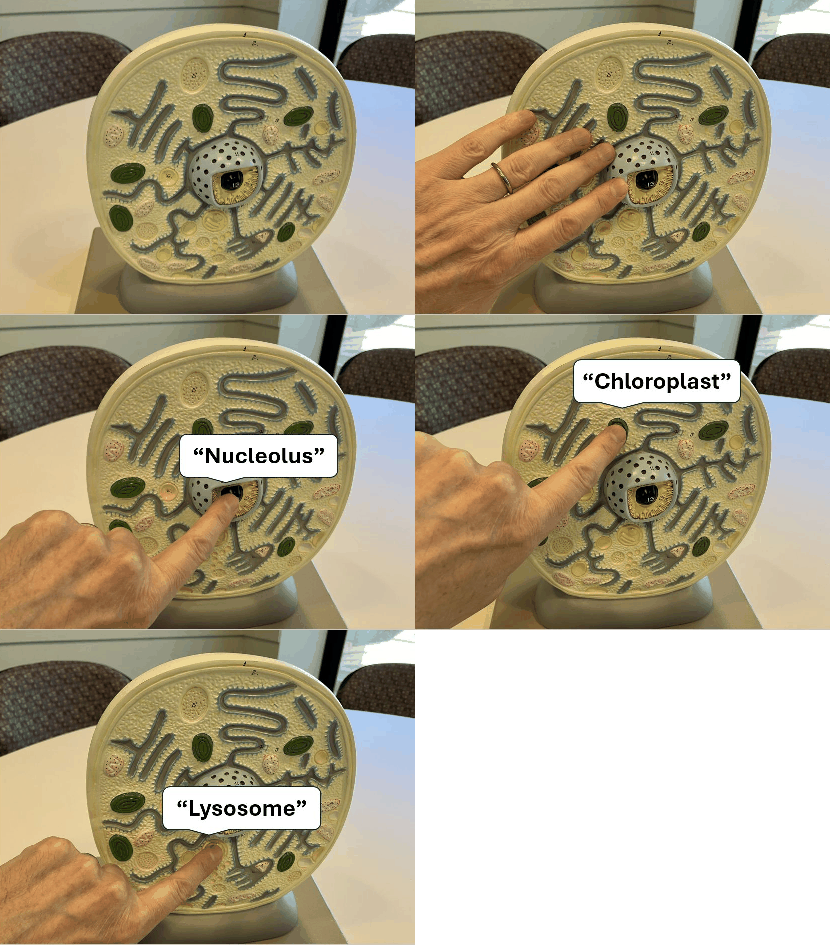
CamIO
CamIO (short for “Camera Input-Output”) is a system to make physical objects (such as documents, maps, devices and 3D models) accessible to blind and visually impaired persons, by providing real-time audio feedback in response to the location on an object that the user is touching. CamIO currently works on iOS using the built-in camera and an inexpensive hand-held stylus, made out of materials such as 3D-printed plastic, paper or wood.
See a short video demonstration of CamIO here , showing how the user can trigger audio labels by pointing a stylus at “hotspots” on a 3D map of a playground. See…
Labs
 Coughlan LabThe goal of our laboratory is to develop and test assistive technology for blind and visually impaired persons that is enabled by computer vision and other sensor technologies.
Centers
 Rehabilitation Engineering Research CenterThe Center's research goal is to develop and apply new scientific knowledge and practical, cost-effective devices to better understand and address the real-world problems of blind, visually impaired, and deaf-blind...