

Event Date:
Sunday, October 26th, 2025 – 11:00 AM to 4:30 PM
Host:
Bay Area Science Festival
Abstract
SKERI Scientists are headed to the Bay Area Science Festival!
Come find us at UCSF’s Mission Bay Conference Center pub lounge and check out our demos (descriptions below):
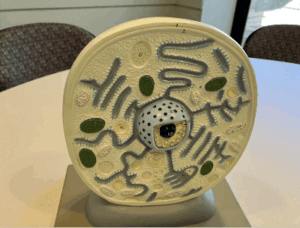
Point and Listen: Getting Tactile Materials to Talk, Drs James Coughlan and Nasif Zaman
Blind individuals often use the sense of touch to explore objects in the world. Scientists at SKERI are using computer vision to increase the amount of information a touch can provide. Point to a feature on an object (like a mountain peak on a relief map) and hear more about it (like “Mount Shasta, elevation 14,162 feet”) using the CamIO system. This system, which runs on any smartphone or computer, was developed to help blind individuals get more information about tactile materials like tactile maps, tactile graphics and 3D models.
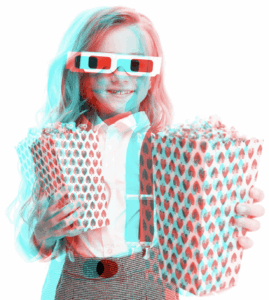
3D Vision: a festival of illusion, Drs. Adrien Chopin and Jade Guénot
Prepare to have your eyes and brain tricked! Step into our exhibit to see how your vision creates incredible 3D images—and how easily the system can be fooled. You’ll put on special glasses to make objects pop right out of the screen, revealing camouflaged animals instantly and testing your hidden 3D super-skills. We’ll use a challenging peg board to show how 3D sight affects grabbing things in the real world. Finally, watch a surprising trick called binocular rivalry, demonstrating how unstable vision can be, causing your perception to flip back and forth!
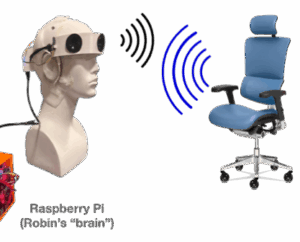 Meet Robin: a human echolocation aid! Dr. Santani Teng, Pushpita Bhattacharyya, and Ryan Tam
Like bats and dolphins, some blind humans can echolocate — using reflected sounds to sense and navigate the world. While humans typically use audible clicks, bats use ultrasonic frequencies that provide finer detail, but are too high-pitched for us to hear. Inspired by bats, we’ve developed “Robin” — a simple device that sends out ultrasonic pulses, records their echoes, and transforms them into sounds you can hear. In this demo, you’ll listen to echo recordings Robin captured from different objects and discover how simple signal manipulations can make them easier to tell apart — even for complete beginners!
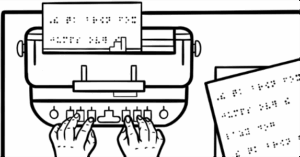 Braille: a tactile reading and writing system, Dr. Santani Teng, Pushpita Bhattacharyya, and Ryan Tam
Braille is a tactile reading and writing system used by blind and low-vision people, where raised dot patterns represent text symbols, such as letters of the alphabet, letter groupings, punctuation marks, numbers, and even mathematical symbols and musical notation! Braille readers sweep their fingers across the dots, transforming them into meaningful concepts. Stop by to learn how to read and write your name in braille, try your hand at some braille reading tasks, and find out more about how our lab combines motion-tracking and brain recordings (EEG) to study how a braille reader’s brain creates meaning out of tactile text!
 See your blindspot! Dr. Andrew Freedman
Every eye has a small patch of retina without photoreceptors where the optic nerve leaves the eye on its way to the brain. At this anatomically defined blind spot, we can’t see anything at all. You’d never know it was there, though, because our brains fill in that spot with what we expect to see there! This demo will help you find your blind spot – watch as dots vanish into thin air and see how expertly your brain deals with missing visual input!
Labs
 Coughlan LabThe goal of our laboratory is to develop and test assistive technology for blind and visually impaired persons that is enabled by computer vision and other sensor technologies.
 Verghese LabOur laboratory studies the mechanisms of healthy vision and action, as well as the basis of attention and visual adaptation in clinical populations.
 Teng LabParticipate in our studies! Visit Teng Lab Experiment Participation for details. Welcome to the Cognition, Action, and Neural Dynamics Laboratory We aim to better understand how people perceive, interact with, and...
Centers
 Rehabilitation Engineering Research CenterThe Center's research goal is to develop and apply new scientific knowledge and practical, cost-effective devices to better understand and address the real-world problems of blind, visually impaired, and deaf-blind...