
June 16th, 2024
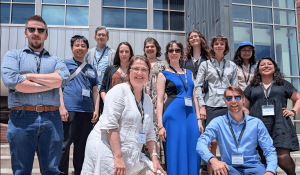 Reno, NV – June 3, 2024 – The Smith-Kettlewell Eye Research Institute played a key role at this year’s International Multisensory Research Forum (IMRF) in Reno, Nevada, beginning June 17, 2024. An all-SKERI symposium “Shifting Sensory Reliance: Adaptive Strategies in Vision Impairment and Blindness,” organized by Drs Catherine Agathos and Haydée Garcia-Lazaro (both postdoctoral fellows at SKERI), delved into the many ways individuals with partial or total vision loss compensate for deficits in visual processing and perception.
This symposium addressed a spectrum of visual impairments, from loss of stereopsis and central visual field loss to complete blindness, with a special focus on age-related changes. As older adults often exhibit deficits in multisensory integration while increasingly relying on multimodal information for accurate perception, these insights are particularly significant.
Speakers from Smith-Kettlewell highlighted how individuals leverage spared vision, cross-modal plasticity, and perceptual learning to enhance their functional abilities. Key presentations included:
- Adrien Chopin will explore the differential impacts of stereopsis loss across age groups in his presentation, “Does losing stereoscopic vision matter? Age-related differences in cue-combination compensation.” Chopin’s research suggests that older adults rely more heavily on stereoscopic depth cues than younger adults.
- Catherine Agathos will discuss “Changes in sensory reweighting in age-related central visual field loss,” focusing on how these changes relate to fall risk among older adults.
- Jade Guenot will present on the efficacy of combined electrical brain stimulation and perceptual learning in improving sensory integration for those with central visual field loss.
- Santani Teng will showcase “Integrating across hands in bimanual braille reading,” providing insights into how Braille reading patterns in blind individuals correlate with reading expertise and efficiency. Additionally, Teng will demonstrate the neural mechanisms enabling expert blind echolocators to rapidly integrate echo cues for localization.
- Haydée Garcia-Lazaro will delve into the Neural dynamics of human click-based echolocation, shedding light on this remarkable compensatory strategy.
This collection of studies underscores the brain’s remarkable adaptability and its ability to creatively employ various compensation techniques following vision loss. The techniques range from leveraging spared vision and sensory substitution to enhancing perception via alternative modalities such as hearing and touch, and honing perceptual expertise through extensive training.
The symposium culminated in a panel discussion with all speakers, providing an opportunity for deeper engagement and exploration of these adaptive strategies. These insights have profound implications for developing customized interventions to enhance functional abilities and quality of life for individuals with varying degrees of visual impairment.
Additional presentations included a talk by Christian Sinnott where he discussed how “Noise exposure and noise-induced hearing loss predicts visual dependence in the rod-and-frame task” and two poster presentations:

- “Vestibular Damage due to Noise Exposure Leads to Significant Sensory Adaptations During Quiet Stance” by Natela Shanidze, Catherine Agathos, & Anca Velisar
- “The Effect of Plantar Cutaneous Afferents on Visual Field Dependence in Older Adults” by Pierre-Olivier Morin, Christine Assaiante, Angelo Arleo, & Catherine Agathos
Dr. Lora Likova, a Senior Scientist at SKERI, is a member of the IMRF 2024 Scientific Committee.
Projects

Human Echolocation
What is echolocation? Sometimes, the surrounding world is too dark and silent for typical vision and hearing. This is true in deep caves, for example, or in murky water where little light penetrates. Animals living in these environments often have the ability to echolocate: They make sounds and listen for their reflections. Like turning on a flashlight in a dark room, echolocation is a way to illuminate objects and spaces actively using sound.
Mobility and Fall Risk in Central Visual Field Loss
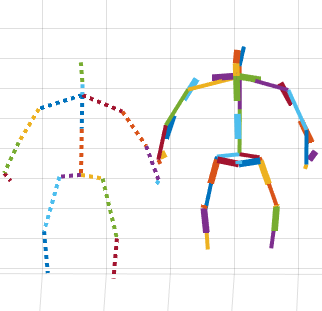
Age-related macular degeneration (AMD) is the most common cause of vision loss in the developed world. Central visual field loss due to diseases such as AMD is a large and growing problem. It is also associated with higher risk of falls and, therefore injury. Although much has been done to understand visual limitations associated with this condition, one of its most dangerous and poorly understood outcomes is the increase in the risk of falls, which can be debilitating and even deadly, especially in the age group most affected by AMD. The exact reasons for the increased fall risk are unknown…

Effects of Noise Exposure Across the Lifespan on Balance and Stability in Older Adults
Falls in older adults are common, have high societal and monetary costs, often lead to injury and can even be fatal. It is known that noise can damage the vestibular periphery resulting in postural instability and compromised balance. This project investigates how natural aging is accelerated by lifetime noise exposure, and how that can lead to impaired vestibular function, contributing to propensity to fall.
Vergence and Stereopsis in Amblyopia & Strabismus
Vergence to disparity targets in the central visual field is impaired in individuals with amblyopia and strabismus.
Labs
 Eye-Head Movement LaboratoryOur laboratory is interested in how changes in visual and/or vestibular function affect eye/head coordination, balance, and mobility, particularly in aging. We are currently pursuing two main lines of research:...
 Teng LabParticipate in our studies! Visit Teng Lab Experiment Participation for details. Welcome to the Cognition, Action, and Neural Dynamics Laboratory We aim to better understand how people perceive, interact with, and...
 Verghese LabOur laboratory studies the mechanisms of healthy vision and action, as well as the basis of attention and visual adaptation in clinical populations.
Centers
 Rehabilitation Engineering Research CenterThe Center's research goal is to develop and apply new scientific knowledge and practical, cost-effective devices to better understand and address the real-world problems of blind, visually impaired, and deaf-blind...