
Neurodynamics of Braille Reading
[Under construction]
Neuroimaging techniques such as EEG/MEG and fMRI offer the potential to trace the propagation of Braille information through the brain as it transforms from a dot pattern to meaningful alphabetic information, and comparing this to the analogous processing stream of printed letters in sighted people.
Completed
t-Scratch: Tangible Programming Environment
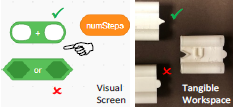
tScratch: Tangible Programming Environment Targeted for Students who are Blind or Visually Impaired
Introductory programming languages are overwhelmingly designed with sighted students in mind. Our goal is to expand and enhance scratch (https://scratch.mit.edu/ ), a block-based visual programming language and online community targeted primarily at children with Universal Design for Learning (UDL) concepts. The addition of tactile programming tiles, a specialized haptic coding grid, and an auditory interface will provide beginning programming instruction for students either as individual…
The Kinematics of Braille Reading
[Under construction]
When blind persons read braille, a system of raised dots for tactile reading and writing, how is the information processed? How do a few indentations on the fingerpads translate to linguistic information, and how does the text, in turn, influence the motions of the hands reading it? Our work on braille addresses these processes on several levels.
Completed
Upper Depth Limit Across Visual Field
Stereopsis is important for tasks of daily living such as eye-hand coordination. It is best in central vision but is also mediated by the periphery. Previously we have shown that individuals with central-field loss who have residual stereopsis in the periphery perform better at an eye-hand-coordination task. Here we sought to determine what sets the limit of stereopsis, defined as the largest disparity that supports the sustained appearance of depth, in the near periphery in healthy individuals.
Active
Postdoctoral Training in Vision Research
The Smith-Kettlewell Eye Research Institute (SKERI) is an NEI Institutional Training Grant Awardee. The grant was awarded to provide postdoctoral training in basic and clinical science relevant to translational vision research and rehabilitation.

Active
Human Echolocation
What is echolocation? Sometimes, the surrounding world is too dark and silent for typical vision and hearing. This is true in deep caves, for example, or in murky water where little light penetrates. Animals living in these environments often have the ability to echolocate: They make sounds and listen for their reflections. Like turning on a flashlight in a dark room, echolocation is a way to illuminate objects and spaces actively using sound.
Active
Blindness and Low Vision Support Group
Join Annemarie Rossi, Occupational Therapist, and scientists at Smith-Kettlewell to share experiences and learn about resources for members of the blind and low vision community through the Blindness and Low Vision Support Group, founded by Dr. Donald Fletcher, M.D.

Completed
Motion Perception in Central Field Loss
The project investigates motion perception in individuals with vision loss due to central retinal lesion, but who retain healthy peripheral retina. Healthy peripheral retina is exquisitely sensitive to fast speeds, however, there is limited and conflicting information about motion processing in residual peripheral retina in patients with central field loss, often due to macular degeneration. We use psychophysical and eye tracking approaches to systematically probe speed and direction sensitivity in this population.
Completed
ZoomBoard: an Affordable, Portable System to Improve Access to Presentations and Lecture Notes for Low Vision Viewers
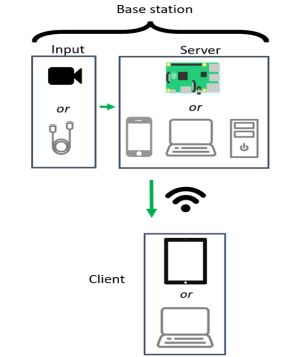
The goal of the project is to develop a “ZoomBoard” system that students with low vision can use to better access visual material on a whiteboard or blackboard. The prototype version of the system that we plan to develop in this grant will consist of a dedicated camera system placed by the teacher to capture a view of the board, which wirelessly transmits a video stream that will be displayed on a student’s iPad. The student will use the ZoomBoard app to view this video stream, zoom in on any region of interest using a pinch gesture on the iPad, and apply image enhancements such as contrast…