Publication Types
Abstract
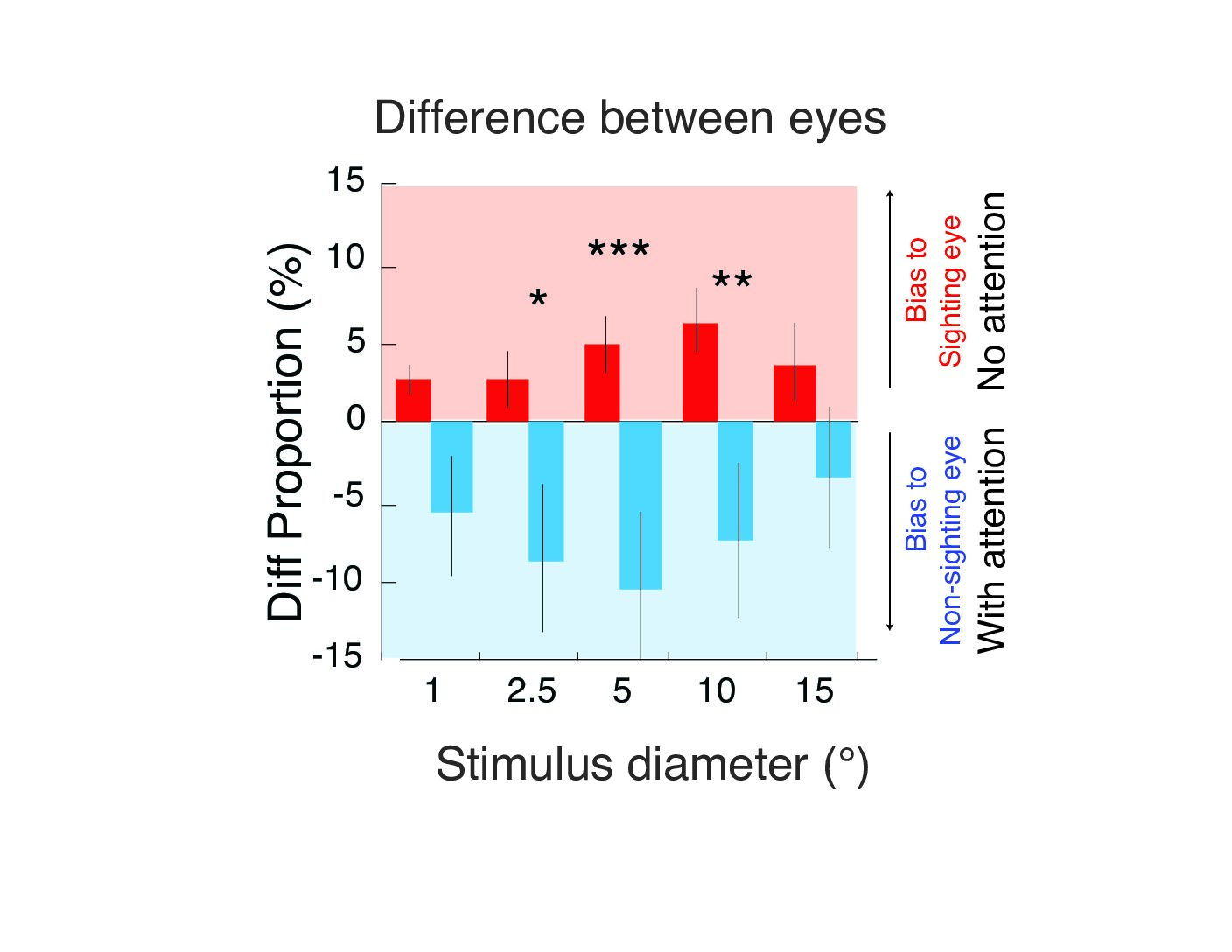
PURPOSE: When dissimilar images are presented to the two eyes, perception alternates between them, a phenomenon known as binocular rivalry. This study aimed to investigate how attentional eye selection modulates sensory eye dominance across a range of stimulus sizes during binocular rivalry. METHODS: Twelve normally sighted observers (mean age: 34 ± 14 years; six females) viewed dichoptically presented orthogonal gratings with distinct contrast-reversal rates (6 Hz and 7.5 Hz). Binocular rivalry was assessed across five stimulus sizes (1°, 2.5°, 5°, 10°, 15°) under two conditions: without attention and with attention directed to the nonsighting eye, as determined by the hole-in-the-card test. The occurrence of perceptual alterations, the duration of perceptual dominance, and the relative proportion of monocular and mixed percepts were measured. RESULTS: In the absence of directed attention, the sighting eye exhibited greater perceptual dominance, evidenced by higher occurrence rates, longer dominance durations, and larger dominance proportions. When attention was selectively directed to stimuli of the nonsighting eye, perceptual dominance shifted toward the attended nonsighting eye, with the most pronounced effect observed at the 5° stimulus size. The proportion of mixed percepts remained unaffected by such selective attention across all stimulus sizes. CONCLUSIONS: Voluntary attentional eye selection can modulate sensory eye dominance during binocular rivalry, with the magnitude of this modulation varying with stimulus size. TRANSLATIONAL RELEVANCE: These findings highlight the potential of attentional strategies in modulating sensory eye dominance, offering insight that may inform therapeutic interventions for visual disorders such as amblyopia.